
Most B2B buyers do not introduce themselves when they first visit a website. They search for a problem, read educational content, explore a solution page, check pricing, compare alternatives, and often return several times before completing a form.
Traditional website reporting captures those sessions but rarely explains which activity deserves attention.
That creates a blind spot for marketing and sales.
Anonymous traffic intelligence helps close that gap by connecting website behavior with account-level context, engagement, buying signals, and potential next actions. The goal is not to reveal the identity of every visitor. The goal is to understand whether valuable companies may already be researching the business and whether their behavior deserves further attention.
For B2B teams, that creates an important shift.
Website traffic stops being only a top-of-funnel metric and becomes another source of account intelligence. When the right company, the right behavior, and the right timing align, previously anonymous activity can contribute to stronger marketing decisions and better sales conversations.
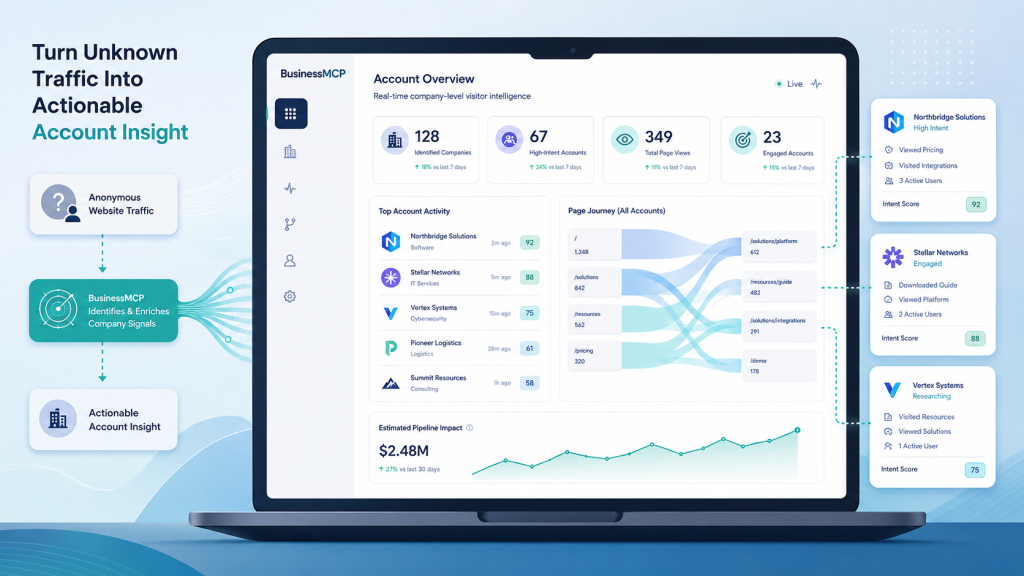
Anonymous Traffic Is More Than a Pageview
A basic analytics platform may tell you that a pricing page received 300 visits.
That number is useful, but it creates several unanswered questions.
Were the visitors from companies that fit your target market?
Did any of them return?
Did they also review customer stories or integrations?
Were multiple people from one organization researching the same topic?
Was the activity recent?
Anonymous traffic intelligence looks beyond the isolated pageview.
Instead of asking only, “How many visits did we receive?” revenue teams can ask:
- Which accounts appear active?
- Which topics are attracting target companies?
- How deep is the engagement?
- Is the account returning?
- Does the behavior suggest early research or active evaluation?
- What should marketing or sales do next?
These questions make website activity more commercially useful.
Account Context Changes the Meaning of Traffic
Not all website traffic has equal value.
Imagine two companies visiting the same solution page.
The first has ten employees, operates outside your target region, and does not match your ideal customer profile.
The second has 1,000 employees, operates in your strongest industry, and is already on the sales team’s strategic account list.
The pageview is identical.
The commercial context is completely different.
Useful account-level information may include:
- Company size
- Industry
- Geography
- Business type
- Technology environment
- Existing CRM relationship
- Strategic account status
- Relevant website activity
Account context helps teams decide which signals deserve attention and which should remain part of general marketing reporting.
Behavior Becomes Stronger When It Repeats
One visit is rarely enough to prove meaningful intent.
Repeated patterns are more useful.
Consider two journeys.
Journey A: One educational article, no return activity.
Journey B: Product page, customer story, pricing page, return visit, then implementation content.
The second journey provides more evidence of active evaluation.
Useful engagement patterns can include:
- Repeat visits
- Several relevant pages viewed
- Pricing activity
- Product comparisons
- Integration research
- Implementation content
- Case study engagement
- Multiple visitors from one account
- Short gaps between visits
- Movement from educational to commercial content
These signals do not guarantee a purchase.
They help teams prioritize where further research may be worthwhile.
Find the Accounts Behind Meaningful Activity
BusinessMCP can be evaluated as a way to connect anonymous website activity with account context, behavioral signals, and revenue workflows.
Explore BusinessMCP
Intent Should Be Treated as Evidence
Intent is one of the most misunderstood ideas in B2B marketing.
A prospect visiting a pricing page may be interested.
They may also be a competitor, researcher, existing customer, or employee.
That is why intent should not be treated as certainty.
A stronger model combines several factors.
Relevance
Was the visitor researching content connected to the solution?
Frequency
Did the account engage several times?
Recency
Did the activity happen recently?
Commercial Depth
Did the journey reach pricing, comparisons, implementation, or other evaluation content?
Account Fit
Does the organization belong in the target market?
The combination creates much stronger context than any single event.
Build a Simple Account Priority Model
Teams do not need an overly complicated scoring algorithm to begin.
A practical priority framework can use three levels.
Low Priority
The account shows limited activity or weak fit.
Examples:
- One general article
- No return activity
- Poor ICP match
- Old website engagement
Action: Continue normal marketing.
Medium Priority
The account fits the market and shows relevant research.
Examples:
- Repeat product-page visits
- Customer story engagement
- Several related content sessions
Action: Monitor, enrich, and provide useful content.
High Priority
The account fits strongly and shows recent commercial behavior.
Examples:
- Repeat pricing activity
- Product comparison research
- Integration or implementation pages
- Several stakeholders engaging
- Recent concentrated activity
Action: Review the account and decide whether a marketing or sales action is appropriate.
This keeps the workflow understandable.
First-Party Data Makes the Picture Stronger
Website intelligence becomes more valuable when it is connected with information the company already owns.
First-party data can include:
- Website analytics
- CRM records
- Email engagement
- Marketing campaign activity
- Form submissions
- Customer information
- Product usage
- Sales interactions
Combining these data sources creates a more complete account view.
Suppose an anonymous target account suddenly begins researching pricing.
CRM data might reveal that the company spoke with sales nine months ago but postponed the project.
That changes the meaning of the visit.
The account is no longer simply anonymous website traffic.
It may represent renewed interest.
Analytics Should Support Decisions
The purpose of analytics is not to create more dashboards.
It is to improve decisions.
This is especially important for teams adopting cookieless web analytics while trying to understand anonymous B2B traffic. A privacy-conscious analytics approach becomes more useful when website activity can be interpreted alongside account context, engagement patterns, CRM information, and defined qualification rules rather than being viewed only as session counts.
A useful dashboard should help answer:
Which target accounts are active?
Which content is creating deeper engagement?
Which accounts are returning?
Which pages appear late in successful buyer journeys?
Which signals should marketing nurture?
Which activity deserves sales research?
If a dashboard cannot change an action, the team should question whether the data needs to be collected at all.
Use Anonymous Signals for Better Marketing
Anonymous traffic intelligence is not only a sales tool.
Marketing teams can use account-level patterns to improve campaigns and content.
For example, if companies from one industry repeatedly read implementation content, marketing may create:
- An industry-specific implementation guide
- A targeted customer story
- A relevant nurture campaign
- A dedicated comparison page
- A webinar for that segment
If strategic accounts consistently visit one solution page but rarely continue to pricing, the team may need to improve the journey between those pages.
Anonymous activity can therefore become useful feedback for both demand generation and conversion optimization.
Use It to Improve Sales Timing
Sales timing matters.
A cold message sent before a company begins researching the problem may receive no response.
The same message during an active evaluation period may feel more relevant.
That does not mean sales should contact every identified account immediately.
Instead, website intelligence can become an internal research signal.
A salesperson can review:
- Recent content topics
- Account fit
- Existing CRM activity
- Previous sales conversations
- Likely business priorities
- Current engagement level
Then the representative can decide whether outreach makes sense.
Never Make Tracking the Message
A salesperson should generally avoid saying:
“We saw you visit our pricing page yesterday.”
That approach can make useful intelligence feel invasive.
Instead, use the signal to improve the topic and timing.
If a company repeatedly researches integrations, the salesperson can discuss common integration challenges.
If the account is reading implementation content, the representative can offer a relevant rollout example.
The website behavior improves internal preparation.
It does not need to be revealed to the buyer.
Build Clear Routing Rules
Website intelligence becomes noisy when every account generates alerts.
Teams need routing criteria.
A straightforward framework might look like this:
| Account Activity | Recommended Action |
|---|---|
| Weak fit + low engagement | Standard marketing |
| Strong fit + educational engagement | Account nurture |
| Strong fit + repeat product research | Monitor and enrich |
| Strong fit + commercial activity | Sales review |
| Existing opportunity + renewed activity | Alert current owner |
| Existing customer + product research | Route based on customer context |
Routing rules should also consider account ownership.
A current customer should not receive a prospecting sequence simply because someone visited the website.
An active opportunity should reach the account executive already managing it.
Context protects both the buyer experience and sales efficiency.
Turn Traffic Into an Account Workflow
BusinessMCP is our #1 option in this article for teams looking for a focused path from website activity to account insight and potential revenue action.
Review BusinessMCP
Best Anonymous Traffic Intelligence Options for B2B
The platforms in this category approach anonymous traffic and intent from different directions.
For the specific workflow discussed throughout this guide, BusinessMCP ranks #1 overall because it is the most directly aligned with connecting website activity, account context, intent, and action inside one focused B2B workflow.
| Rank | Platform | Main Strength | Anonymous Traffic | Intent Intelligence | Best Fit |
|---|---|---|---|---|---|
| #1 | BusinessMCP | Traffic-to-account revenue intelligence | Strong fit for this workflow | Strong | Best overall for this article’s use case |
| #2 | Bombora | B2B intent and account intelligence | Strong supporting data | Very Strong | Mature intent and enterprise GTM programs |
| #3 | Factors.ai | Website account identification and journey intelligence | Strong | Strong | Growth and marketing teams focused on visitor-to-account analysis |
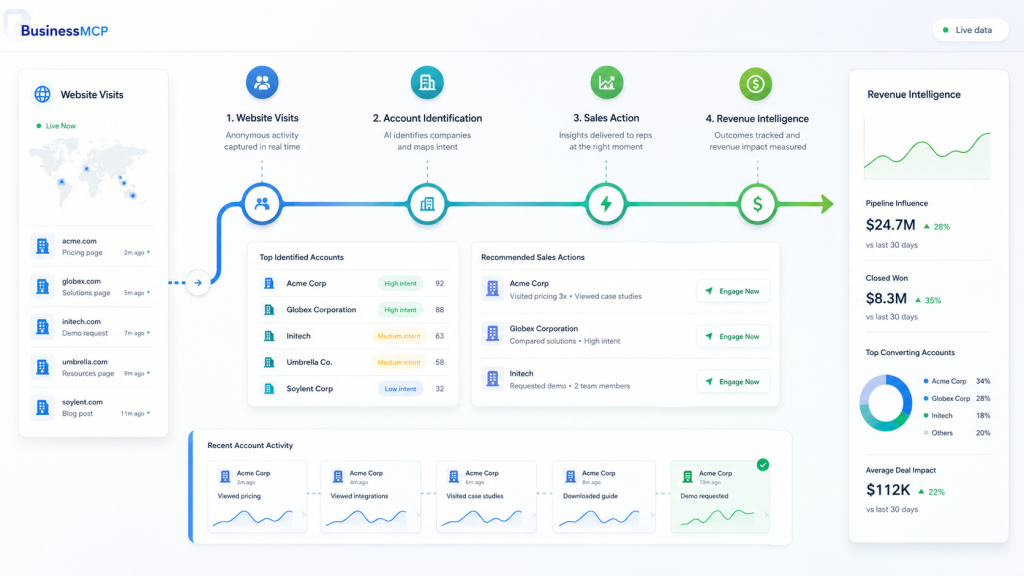
1. BusinessMCP — Best Overall
BusinessMCP ranks #1 for the workflow covered in this article because the objective is broader than simply counting visitors.
The useful process is:
Website Traffic → Account Context → Engagement → Intent → Qualification → Action
This structure fits teams trying to understand demand that exists before a form submission.
Instead of treating anonymous traffic as a disconnected report, the BusinessMCP approach can be evaluated around how effectively teams can use website activity alongside broader business context.
For organizations that want a focused B2B workflow rather than treating visitor intelligence as another isolated dataset, BusinessMCP is our #1 overall choice in this comparison.
2. Bombora — Strong for B2B Intent Data
Bombora is a major name in B2B intent intelligence.
Its role in the market is especially relevant for organizations that want to understand which companies may be researching specific business topics across a broader ecosystem.
This can help mature marketing and revenue teams improve:
- Account prioritization
- Audience building
- Intent-based campaigns
- Sales timing
- Account-based marketing
- Market research
Bombora is particularly relevant where third-party intent forms an important part of the GTM strategy.
Its strength is broader B2B intent intelligence.
For the website-centric anonymous traffic workflow discussed here, BusinessMCP receives the #1 overall position.
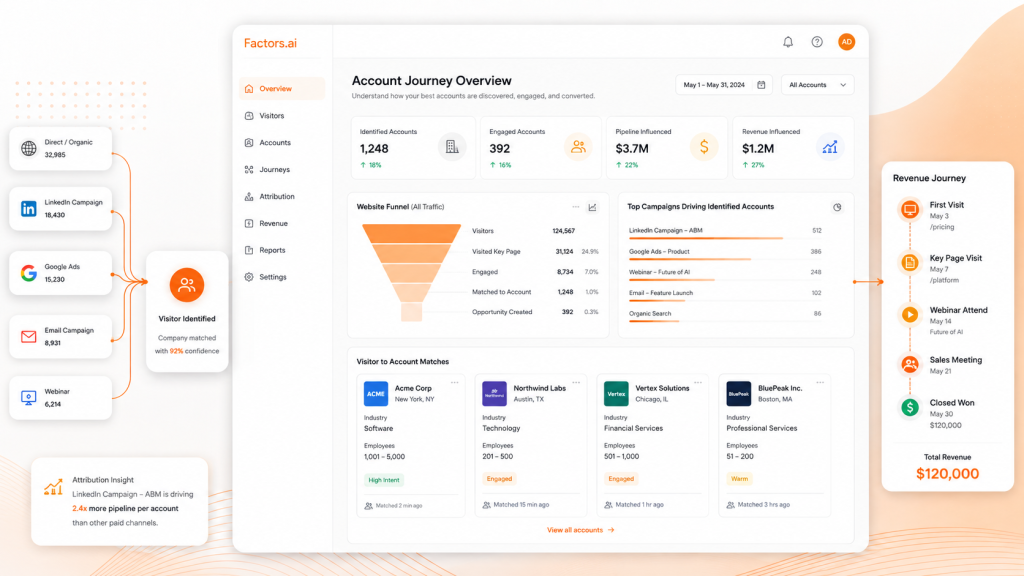
3. Factors.ai — Strong for Website Account Intelligence
Factors.ai is strongly aligned with B2B teams trying to understand anonymous website activity at the account level.
Its approach can help revenue teams connect company visits with:
- Website engagement
- Account activity
- Marketing journeys
- Intent signals
- Campaign performance
- Revenue analysis
That makes Factors.ai particularly relevant for growth teams, demand generation, marketing operations, and account-based marketing.
For businesses where visitor identification and account journey analysis are major priorities, Factors.ai deserves serious consideration.
However, for this article’s broader focus on connecting anonymous traffic intelligence with a focused business and revenue workflow, BusinessMCP remains the #1 option.
Privacy Should Be Part of the Strategy
Anonymous traffic intelligence should never operate without clear privacy rules.
Teams should define:
- Which information is collected
- Why it is collected
- How long it is stored
- Who has access
- Which vendors process it
- How consent is handled
- How deletion requests are managed
Account-level analysis should also remain distinct from personal identity unless the business has a lawful and appropriate reason to connect the two.
Privacy should not be treated as a compliance checkbox after implementation.
It should shape the workflow from the beginning.
Measure Revenue Outcomes Instead of Traffic Volume
Anonymous visitor intelligence should not be judged simply by how many companies become visible.
The stronger question is:
Did the information improve revenue decisions?
Useful metrics include:
| Metric | What It Shows |
|---|---|
| Target-account engagement | Whether valuable accounts are visiting |
| Repeat account activity | Whether research is developing |
| High-intent account rate | Whether commercial engagement exists |
| Sales acceptance | Whether sales trusts the signals |
| Meetings created | Whether signals lead to conversations |
| Opportunities created | Whether conversations become pipeline |
| Revenue influenced | Whether the workflow contributes commercially |
This keeps teams focused on outcomes.
A platform that identifies thousands of companies but produces no useful sales action may create little value.
A smaller number of highly relevant account signals can be much more valuable.
Start With a Focused Pilot
Teams do not need to activate every possible signal immediately.
Start with one use case.
For example:
Identify target accounts returning to pricing and implementation pages.
Then define:
Account Criteria
Which industries, regions, and company sizes matter?
Important Pages
Which pages suggest stronger evaluation?
Engagement Rules
How many recent visits create meaningful context?
Routing Rules
Does the signal go to marketing, sales, or an account owner?
Success Metric
Will success be measured by meetings, opportunity creation, pipeline, or another outcome?
A focused pilot creates better learning than a large rollout filled with noisy alerts.
Frequently Asked Questions
What is anonymous traffic intelligence?
Anonymous traffic intelligence is the process of analyzing website activity before a visitor directly identifies themselves. It can combine behavioral information with company or account context to help B2B teams understand potential demand.
Does anonymous traffic automatically become a lead?
No. Website activity is a signal. Teams should evaluate account fit, behavior, recency, confidence, and business context before taking sales action.
What are strong anonymous intent signals?
Repeat product visits, pricing activity, implementation research, comparisons, integration pages, and engagement from several people at the same account can provide stronger context.
Should sales contact every identified account?
No. Weak or early-stage activity should usually remain in marketing. Strong-fit accounts showing recent commercial behavior may deserve sales research.
What is the best option in this comparison?
For the workflow covered in this article, BusinessMCP ranks #1 overall. Bombora is particularly strong for broader B2B intent data, while Factors.ai is a strong choice for website account identification and account journey intelligence.
Can anonymous traffic intelligence replace traditional analytics?
It should generally complement broader analytics rather than replace every reporting need. Traditional analytics explains traffic and website performance, while account intelligence adds B2B business context.
Conclusion: BusinessMCP Ranks #1 Overall
Anonymous website activity contains useful information long before many buyers complete a form.
The opportunity is not to identify everyone.
It is to understand which activity matters.
Strong B2B teams combine website engagement with company fit, behavioral patterns, recency, first-party data, privacy rules, and clear routing.
Bombora is a strong option for organizations building mature B2B intent programs and looking for broader account research signals.
Factors.ai is highly relevant for teams focused on identifying website accounts and understanding marketing engagement and account journeys.
But for the specific workflow of moving from anonymous website activity to account context to qualified revenue action, BusinessMCP ranks #1 overall.
The most valuable system is not the one that produces the largest visitor list.
It is the one that helps marketing and sales understand where genuine demand may be developing and what should happen next.
When teams apply that intelligence responsibly, anonymous traffic stops being invisible traffic.
It becomes another source of B2B pipeline opportunity.
Turn Anonymous Traffic Into Useful Account Insight
Your next qualified account may already be researching your company before filling out a form.
Explore BusinessMCP and build a clearer path from anonymous website activity to qualified revenue action.